Featured

Intro to My Mental Health

Mental Health Journal

Hello,

For those of you unaware, my name is Rebekah Naylor, but most call me Beka. As I was struggling with what I wanted to write about or the purpose behind my writing, I decided to think about my audience, you. I decided to do something a little bit out of the box, more informative than anything else. I want you to know what it is like in a normal day of someone with severe problems with mental health. I know many of you have probably come into contact with this, and I know some of you probably have some problems yourself. If neither of those are the category that you fall into, then I can all but promise you that eventually, you will.

As someone with a mental illness, there are so many things that I have to deal with on the inside that no one will ever know about. I am in constant battle with my mind over everything you can think of. You see, I have a few different mental illnesses. I have major depressive disorder, panic disorder, derealization/depersonalization disorder, and an addiction to various forms of self harm. So that you are aware of what each means, I will expand on each of these throughout this post.

My Day

From the time I wake up I am plagued with all of these horrid thoughts, everything from wanting to kill myself to whether or not I actually exist. The first thing on my mind is how I can hurt myself that day. I consider starving myself, going for the scissors in my desk drawer, or taking a shower so hot that it boils my skin. This is my self harm addiction. I do not have access to a knife here on campus, and therefore cannot harm myself with that, but that does not mean that I am incapable of harming myself. It just means that my mind has to get creative.

After I’ve forced myself out of that form of thought, I rush through the bathroom to get ready for class, all the while seeing myself in the mirror and hating every second of it. My clothes never fit right, my hair is drab, and if I didn’t wear contacts, I would feel like a completely irredeemable slob of a human. Before I leave, I have to remember to take my medication, otherwise the withdrawal symptoms can get horrible.

Next, I get to class, sitting in a room full of people that couldn’t care less about the fact that I’m shaking and crying silently to myself. Maybe they don’t even notice; maybe it’s all in my head. As class ends, it takes all of my remaining energy to get up and sling my 50+lb book-bag over my shoulder.

Then, I have to go to lunch. Depending on my mood, I either have to force myself to eat, or limit what I eat. I either hate my body, in which case I am less inclined to eat, or I hate my mind, in which I stress eat- or binge eat. If I have a friend there, I will try to sit with them if they are alone, but if they are with someone, I am afraid to interrupt them or get in the way. If I am completely alone, my thoughts get louder.

I think about all of the things that I’ve done wrong recently. I think of what I could have done better, what I shouldn’t have done, what I was unable to accomplish, and how I made those around me feel. I, also, think about how I am feeling. It’s almost like a mid-day check. I usually find myself in complete depression at this point of the day (my medication is not currently working) and I begin to feel my suicidal ideation get stronger. This basically means that I am unable to stop myself from thinking of ways to kill myself most effectively.

Once I finish lunch, I go on to my next class, which usually ends up the same way that my earlier class does. Shaking, crying, feeling like no one notices, or everyone notices and doesn’t care. I hate how opposing my thoughts can be sometimes. I cannot force myself to have one opinion of something. I spend so much time thinking about every possibility of what others are thinking of me that I usually can’t even pay attention to my class.

Once I’m done with classes for the day, I either go to work, where I clean and listen to music loud enough to drown the inevitable thoughts of suicide, or I go to the library and try to get homework done in between trying to convince myself why I need to live.

Once I get back to my room, I am done with most of my homework for the day and I have to deal with how much I want to self harm. The urge is always so much stronger at night, when I have access to objects that could potentially harm me and I have the bathroom that I can escape to in order to be alone. Most nights, I can withstand the thoughts. Sometimes, I can’t. If I self harm, I am able to quickly go to sleep. If I don’t self harm, it takes me a few hours to pass out from shear exhaustion.

At some point during the day, I am thrown into a form of insanity that doesn’t present itself to very many people. It is informally known as DP/DR, or depersonalization/derealization. This dissociative disorder removes me from reality as well as my own mind on occasion. The world around me begins to feel fictional and I suddenly feel like I have no control over my own body. The only way I can describe it is that it feels like I am staring at a screen, playing a video game with a partially broken controller. Sometimes the controller that I am using gives me just enough control to move, but no control over my words or facial expressions. Sometimes I get control over my words, but I am completely frozen and unable to move. There have also been severe cases where I am unable to feel the ground beneath my feet, the feeling of an object in my hand, or even the pain of bumping into something.
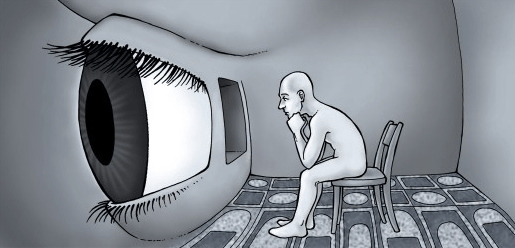
I don’t know where this image comes from, but it is used quite often in reference to how someone with DP/DR feels. I find it to be quite accurate.

More often than not, I am plagued by these various disorders throughout the day. I wish there was more I could do to cut down on how much they affect my day to day life, but all I have is a depression medication that doesn’t work, an anxiety medication that makes me too tired to function, and no solution to any of my other problems.

After getting little to no sleep, I begin the day again….

Not Here

It only lasted 10 minutes; it felt like 10 hours, though somehow only 10 seconds all at the same time. I was having a panic attack. This had happened before, way too many times, in fact, and it would happen again. However, it had never happened in public before, let alone my job. Chick-fil-A is so busy during lunch hour; this probably contributed to the panic attack, but that was probably the worst time and place that it could’ve happened. The thought of how people would react, seeing me in this state, might only make my anxiety worse.

My mind was racing, which probably attributed to how long it felt. My thoughts were short, perhaps shorter than I even remember. I was in a repetitive loop of “not here, not now.” I couldn’t hear anything. The loud noises of my workplace had faded away; the only thing I could hear was my brain. It was yelling at me to get out of that situation as quickly as possible, but I couldn’t move; I was frozen. I was freezing. Why was I cold? It was the dead of summer, and I was standing next to an open window; it had to have been at least 80°F, yet I felt like I had just pulled my hands from a snowbank. I was shaking; I couldn’t control my limbs as I shook with some strange mix of fear and adrenaline. I could feel the tingling, needle-like jabs at my hands. The air felt stagnant on my skin.

People were staring at me; I could feel them watching me. They were probably thinking I was crazy. They were probably wondering what was wrong with me, but I couldn’t speak. My mouth was open; I don’t know if I was trying to speak or trying to breathe, but either way, it wasn’t working. Nothing was going into my lungs, and nothing was coming out of my vocal cords. At this point, I was numb, but not the sensationless kind of numb. The tingling had spread from my hands to the rest of my body, it was starting to creep up my spine, and had ever so slightly begun clouding around my mind.

My thoughts changed at that moment; I was no longer thinking of fleeing, I was thinking of surviving. I felt my knees fail beneath me as I fell to the ground. My hands started clutching at my head as if trying to shield me from their stares, which were falling on me like broken concrete, sharp and heavy. They still don’t know what is happening to me. Why don’t they know? I can’t speak, and now I’m crying.

Someone reached out for me. They grabbed my hand and pulled me to my feet. Then, I was quickly rushed to the back. The air was no longer stagnant, it ripped past me faster than if I were on a roller coaster. I may as well have been; I felt like I was about to throw up. As I got to the back, my senses lit up. I could feel the ice maker next to me, smell the chicken being fried, see all of the hectic bustlings of my coworkers, trying to keep up with lunch rush.

As my coworker, Tonya, pulled me to the back, I stumbled. I was barely able to catch myself, but she caught me and held me up as we continued forward and made it to the back trash room. My breathing was heavy as she opened the door and pulled me through. I could feel the shaking getting worse, and the crying becoming heavier. My eyes were shut tight at this point as I sunk down to the concrete. I could barely hear the mumblings of Tonya; I’m sure that her words were intelligible to anyone who wasn’t having a panic attack, but the words were lost on me.

I started clutching at my head like the roof was caving in. I don’t know what I was trying to accomplish with this, but I guess it helped calm me down a little bit because I could suddenly hear a little bit of what my coworker was saying. I caught a bit of what she said, “okay” … “water” … “help.” Drinking water seemed like a good idea, so I tried to ask if she could get me some. She quickly left, so I figured what I said made at least some sense. I tried to calm down a little. I took several deep breaths.

The trash room was silent, as my sense of hearing came back to me. My ears started to ring as I could hear the cars pass by. Tonya came back out with a cup of ice water. I started chugging it down to try to cool myself down. As my mind came back to me, I realized what had happened. I had a panic attack at work. As the panic fell, my stress went up. Suddenly my fears weren’t unfounded, I had a reason to be nervous; I had a mental breakdown in the middle of my workplace, where all of my coworkers, customers, and bosses could see. This thought sent me into another downward spiral of anxiety and terror.

For the second time in two minutes, I was panicking. My thoughts turned from “not here, not now,” to suddenly visualizing the entirety of the restaurant laughing at me. The visuals that my mind gave me were vividly horrifying. I could picture my bosses’ angry faces and hearing them tell me to leave before I could embarrass the company even more. Before my thoughts could get worse, I could feel the warm sensation of a hand on my back. The sound of comforting words from Tonya as I sat there gasping for breath. She told me that everything would be okay, that it is reasonable to get stressed sometimes, that I’m human and allowed to have a moment to calm down. I found out later that she is a mother of three, so the soothing, motherly comments were just a part of her nature. Between her calming words and my deep breathing, I was quickly calmed down.

My mind was not, in fact, correct about the response I would receive. I thought that the people who witnessed it would’ve been unsympathetic. Instead, those that had witnessed my panic attack were very reassuring, if not worried, about my anxiety. I was so afraid that I would be looked at as insane or weak. However, those around me only looked at me with kind eyes and understanding.

My thoughts…

On the subject of Not Here, I was working on trying to let you into my mind. What I feel, experience, and go through daily is unique to me. The disease of anxiety, however, is not uncommon. In the case of this narrative, I was trying to communicate just the very surface of what it is like to experience a panic attack. I was essentially trying to portray what I personally experience when I have a panic attack.

You should know that this particular panic attack was not merely brought on by the business of work, but by the generalized anxiety disorder that forces me into a state of complete helplessness regularly. This was not a one-time occurrence. In fact, this was not even the only occurrence that week. It was, however, one of the few panic attacks that I was unable to hide from the general public. While I now know that most people will not react negatively towards my disorder, I do know that it can be a significant inconvenience to the people around me and can change the way that people view me.

I am not one who likes to appear weak, let alone show people my vulnerable side. So, when this particular moment happened, I was utterly terrified of how people would respond. Thankfully they were all kind that time, but I have still been conscientious about hiding my anxiety in public ever since.

When the people around me know about my anxiety disorder, they tend to treat me differently. I knew they would, but I thought they would view me as a nuisance. How they treat me, instead, is much different than I anticipated. They look at me with pity; they see me like a lost child or a homeless veteran. They look at me as someone who they can help and build up their own self-esteem along the way. I don’t need them to sit with me and tell me to breathe when I’m anxious. I am well aware that I am unable to breathe during those situations and am doing my absolute best to allow my body to take in oxygen again. It isn’t as simple as “just breathe.” It takes a lot more effort than they could possibly know, just to keep myself from passing out from a lack of oxygen getting to my brain.

Tonya, my coworker from the story, responded surprisingly well to my panic attack. She gave me the comfort that I needed. She helped me to remember where I was and that I didn’t need to get so upset with myself for something that was out of my control.

I suppose an alternate purpose for this story could be to spread awareness, not only about what having a panic attack is genuinely like, but also about what to say in a situation with someone having a panic attack. First step: don’t tell us to breathe, we are human, we know we need to breathe.

Why?

Mental Health Stigma

For years, many have been suffering the effects of the stigma against mental health. The general public has so many preconceived notions that those with mental health are dangerous or unpredictable. While there are some extreme cases where that is true, most of those suffering from mental disorders are mostly ordinary with an illness that slightly alters their day-to-day life. There would be little to no from someone with a physical disorder like diabetes. Yes, a person with depression might require medication or therapy, just as a person with diabetes has a physical dependency on insulin or another medication. Mental illness is just as feasible as any physical illness, and just because those suffering from it are slightly different from the mentally healthy population, that does not mean that they are any more dangerous than anyone else. There are plenty of perfectly sane people who commit murder every day, so if someone with severe schizophrenia shouts some random expletives because they honestly believe that the room around them is on fire, maybe we should have more pity on them than fear of them.

The problem, currently, is that there is such a significant stigma against those with any form of mental illness. There was a study in Alberta, Canada, that looked at the stigma against depression. In this study, 45.9% of participants stated a belief that those suffering from depression are unpredictable, 39.5% stated that they would not vote for someone with depression, 22.1% would not employ them, and 21.9% believe that they are dangerous (Cook and Wang 3). If this study was just based on depression, imagine how the general public feels about some of the more “major” mental illnesses like Schizophrenia and DID. With the way that movies and other forms of media portray those with mental illnesses, it is not surprising how they can be viewed as dangerous or unpredictable. DID, alone, has several “horror” movies made based on its concept. The two movies Identity (2003) and Split (2016) are both referencing those suffering from DID as serial killers and so unbelievably psychotic that they cannot function in everyday society, even though the majority living with DID are not entirely abnormal people.

The stigma against those suffering from mental health does not stop with the mentally ill themselves. The stigma actually can sometimes extend to the family, as well. A study was done correlating the “stigma by association” and the quality of life with family members of those with a mental illness. The study shows that those suffering from the stigma or family burden of having a loved one with a mental illness have a higher rate of psychological distress and a lower quality of life (Remko and Van Der Sanden 1236). The people around those with mental disorders suffer from the distress of helping their loved one(s) cope with their struggles, all the while having to deal with problems of their own, not to mention the stigma against them just for being related to someone with a disorder.

Some might argue that the stigma against mental illness is no longer a problem. That is far from accurate. While studies show that stigma against mental health is decreasing across generations, the percentages of people that would not want others to know about their mental health problems (even family and friends) are increasing (Collins 2-3). This study shows that while people are feeling more and more comfortable around those with mental health problems, they are less and less likely to actively talk about it due to the older generations not being comfortable with it and the fear of others’ judgment. So, while the stigma is slowly decreasing as the newer generations are more accepting of mental illness, it is not decreasing nearly fast enough for people to feel comfortable reaching out for the help they need.

The solution I propose is raising awareness about the reality of mental health. This solution could look like any number of things, including reducing the amount of entirely demoralizing depictions of those with mental illness in the media, encouraging the people around us to talk about mental health and its effect on their lives, and even making educational media that more accurately depicts the reality of the disease that inflicts suffering on many minds every day. There was a group of developers that created a video game called Stigma-Stop to combat the stigma and prejudice against people suffering from mental health disorders. They tested a group of high-schoolers on their beliefs before and after playing the game that involved characters with mental illnesses such as depression and schizophrenia. There was a statistically significant difference between the before and after results of the stigma testing (Cangas 7). The results show that it could be helpful to introduce those with stigma to characters accurately depicting someone with a severe mental illness. Imagine what could happen if we introduce those with stigma to real people suffering from these illnesses. The mere knowledge of knowing the reality behind such diseases of the mind could dramatically reduce many people’s stigma. Stereotypes are only held by those who are unaware or uneducated of reality. The old phrase “knowledge is power” is accurate in that someone who is not knowledgeable about, or at least familiar with, mental illness does not possess the ability to see it as it truly is, an illness that requires the help and understanding of those around them.

With how common mental illness is becoming in our current society, something must be done to help those with a need for support. Everyone either knows someone or knows a family member of someone with psychological problems. Maybe it is something as relatively small as mild anxiety, or maybe it is something as relatively severe as panic disorder. There is such a wide range of illnesses that not only differ in severity but in a person’s ability to function in their society. It would be a lot easier for those suffering to go through life if they receive care and understanding, as opposed to fear and stereotyping.

Currently, our society is stuck in a loop of stigma. There is stigma against those with mental health; those with mental health are unwilling to reach out because of that stigma. The stigma is not reducing quickly enough because those with the stigma are unaware of reality, which could be solved by learning more about mental illness. Those with stigma cannot learn more if those with mental illness do not share, and those with mental illness are afraid to share because there is a stigma in the first place. The vicious cycle has no end; we have to be that end.

We, as a society need to start teaching the unknowledgeable about mental illness. Raising awareness and disproving stigmas and stereotypes is how we break the cycle. It cannot be just a few psychologists and organizations trying to make a change; everyone has to agree to help reduce the stigma. We have nothing without community; how can we have a community if there is an entire population that feels that they have to lie about themselves to make everyone else feel at peace. It is sad and frustrating because there are so many lovely, kind individuals who are unable to be themselves around others out of the fear of rejection.

In conclusion, the stigma surrounding mental health, those suffering from it, and those who are related to those suffering from it, is still a genuine problem that can only be solved by raising awareness and educating the people around us. Some people argue that it is no longer an issue, but evidence suggests that there are still many being affected by it. If we are going to make this world a happier, safer place for people to talk and be themselves, we have to work for it. We cannot leave it to a few doctors, advocates, and courageous people suffering from the illness themselves; we cannot leave it to one video game try to change everything. While those things are helpful, they are not enough. We need to be better as a society; we need to work together as a whole towards the goal of everyone being comfortable acting like themselves, as opposed to hiding who they are out of fear.

References

Cangas, Adolfo J., et al. “Stigma-Stop: A Serious Game against the Stigma toward Mental Health in Educational Settings.” Frontiers in Psychology, vol. 8, 2017. PsycINFO, doi:10.3389/fpsyg.2017.01385.

Collins, Rebecca, et al. “Beliefs Related to Mental Illness Stigma Among California Young Adults.” JSTOR, 2014, doi:10.7249/rr819.

Cook, Trevor M, and Wang, Jianli. “Descriptive Epidemiology of Stigma against Depression in a General Population Sample in Alberta.” BMC Psychiatry, vol. 10, no. 1, 2010. PsycINFO, doi:10.1186/1471-244x-10-29.

Remko L. M. Van Der Sanden, et al. “Stigma by Association and Family Burden among Family Members of People with Mental Illness: the Mediating Role of Coping.” Social Psychiatry and Psychiatric Epidemiology, vol. 51, no. 9, 2016, pp. 1233–1245. PsycINFO, doi:10.1007/s00127-016-1256-x.

Design a site like this with WordPress.com
Get started